Japanese Nanban Lacquer Cabinet, circa 1600

Furniture

17th century

Japanese Nanban Lacquer Cabinet, circa 1600

1

Furniture du 17th century

Japanese Nanban Lacquer Cabinet, circa 1600

DIMENSIONS : l. 19.69 .inH. 12.99 .inP. 12.8 .in

MATERIAUX : Japanese lacquer, Mother of Pearl

PROVENANCE : Japan

PRICE : Contact us

REQUEST INFORMATION

?

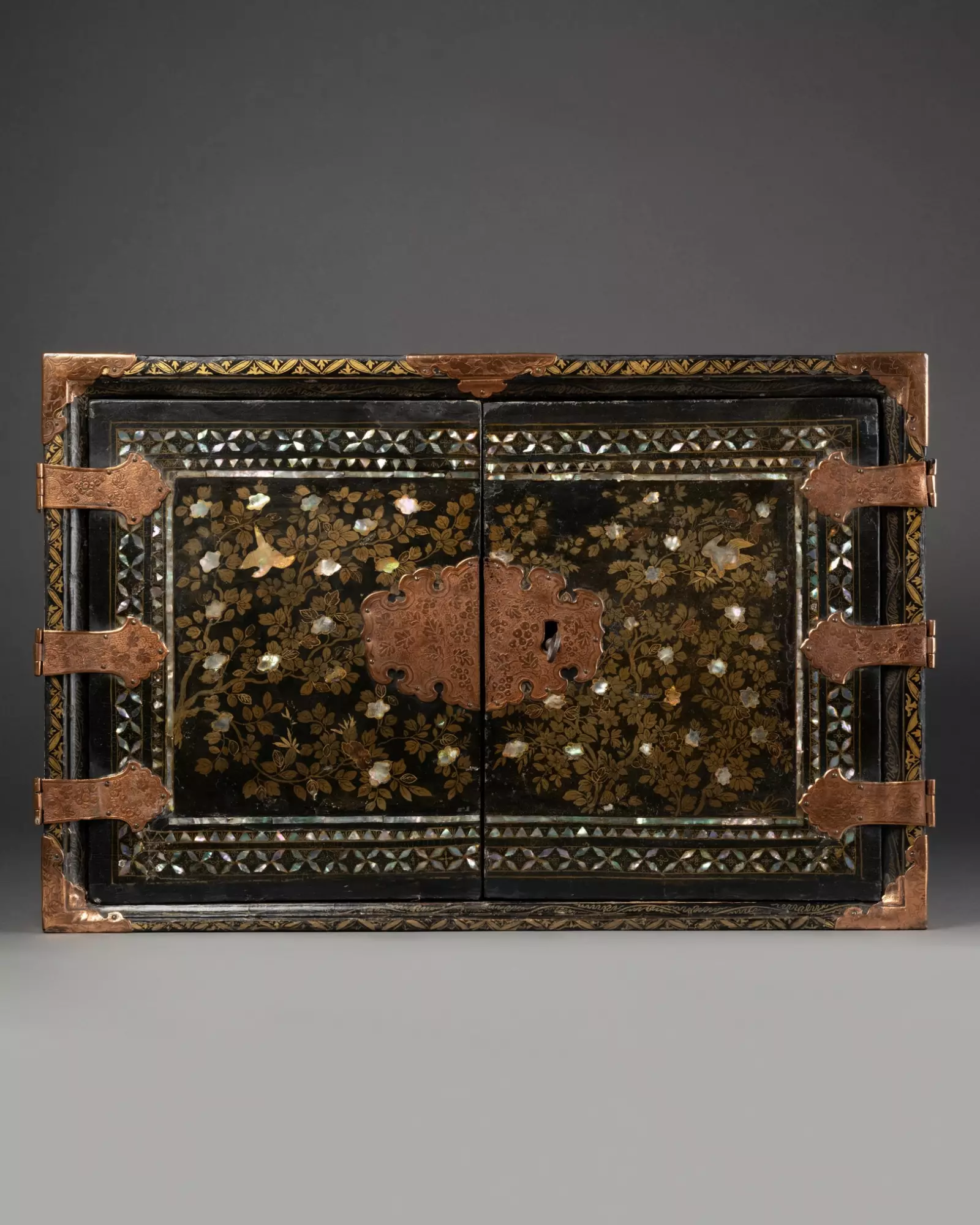
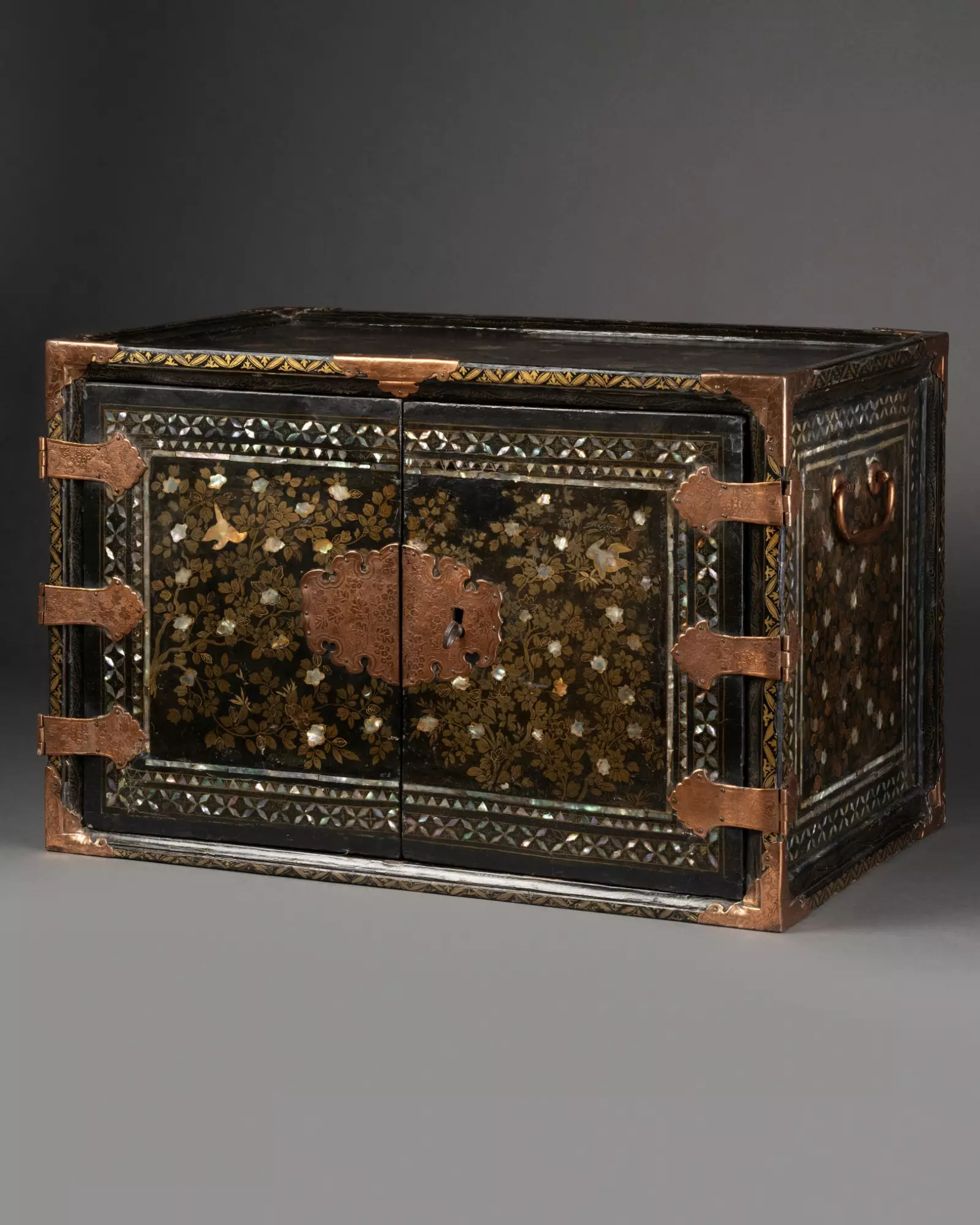
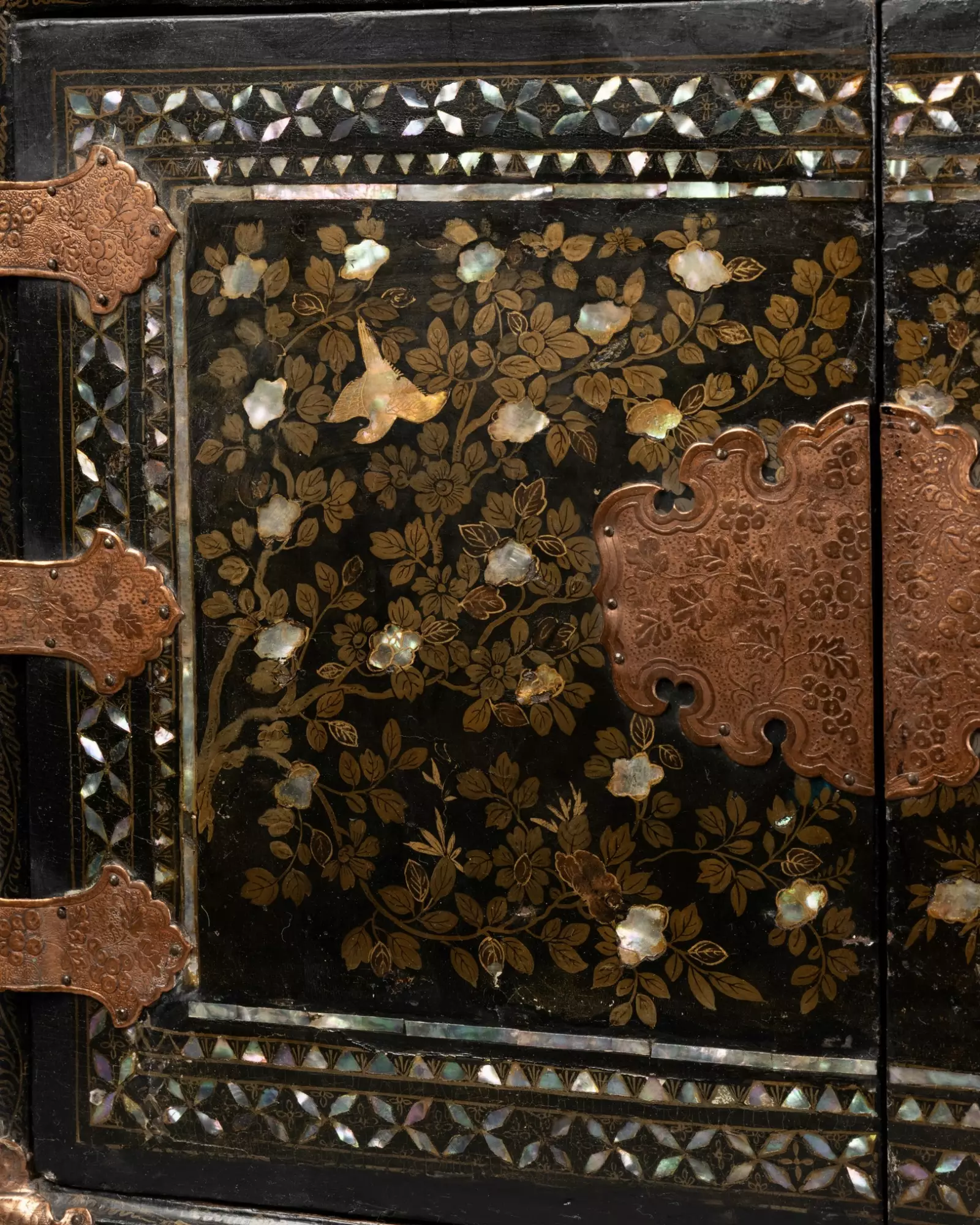
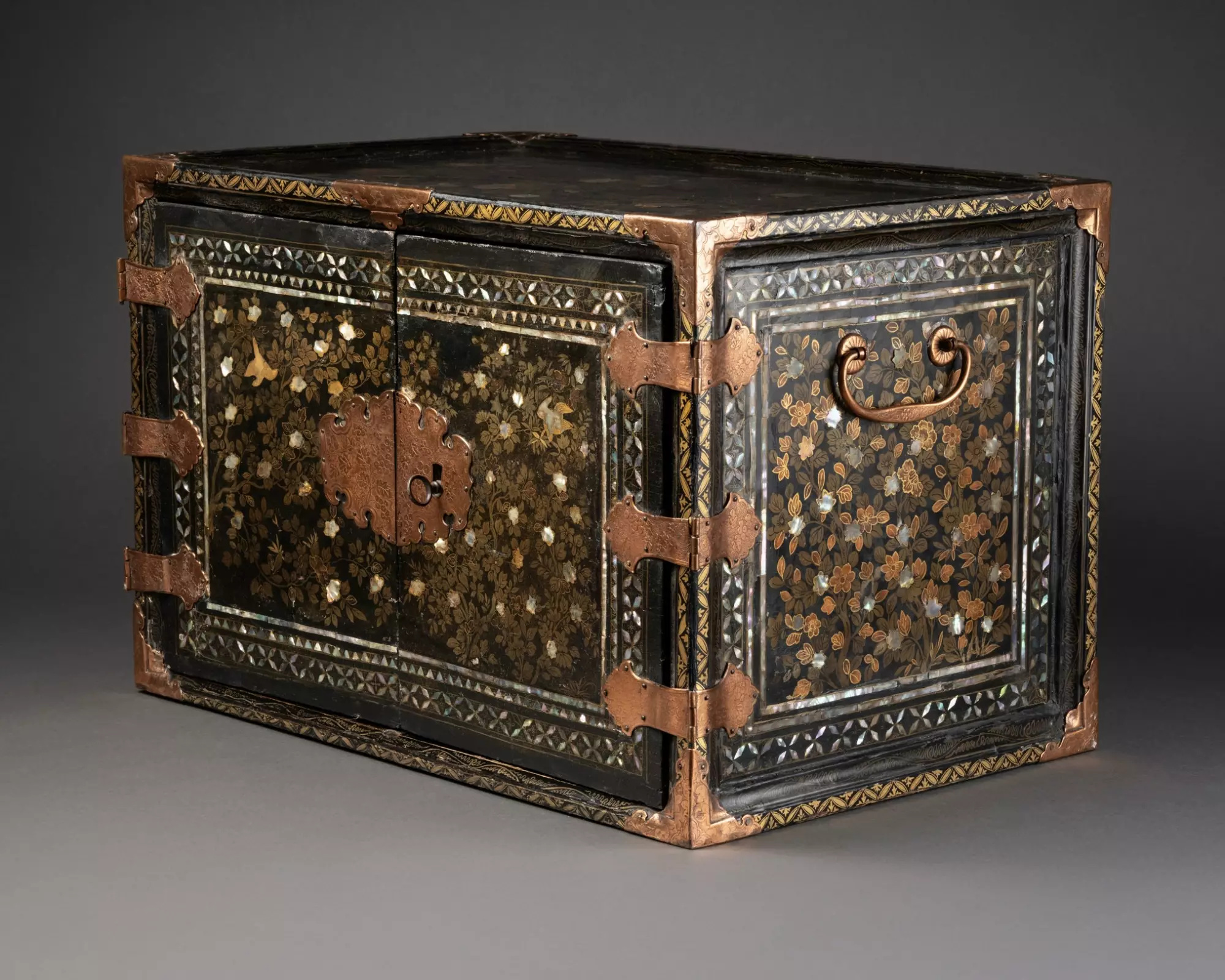
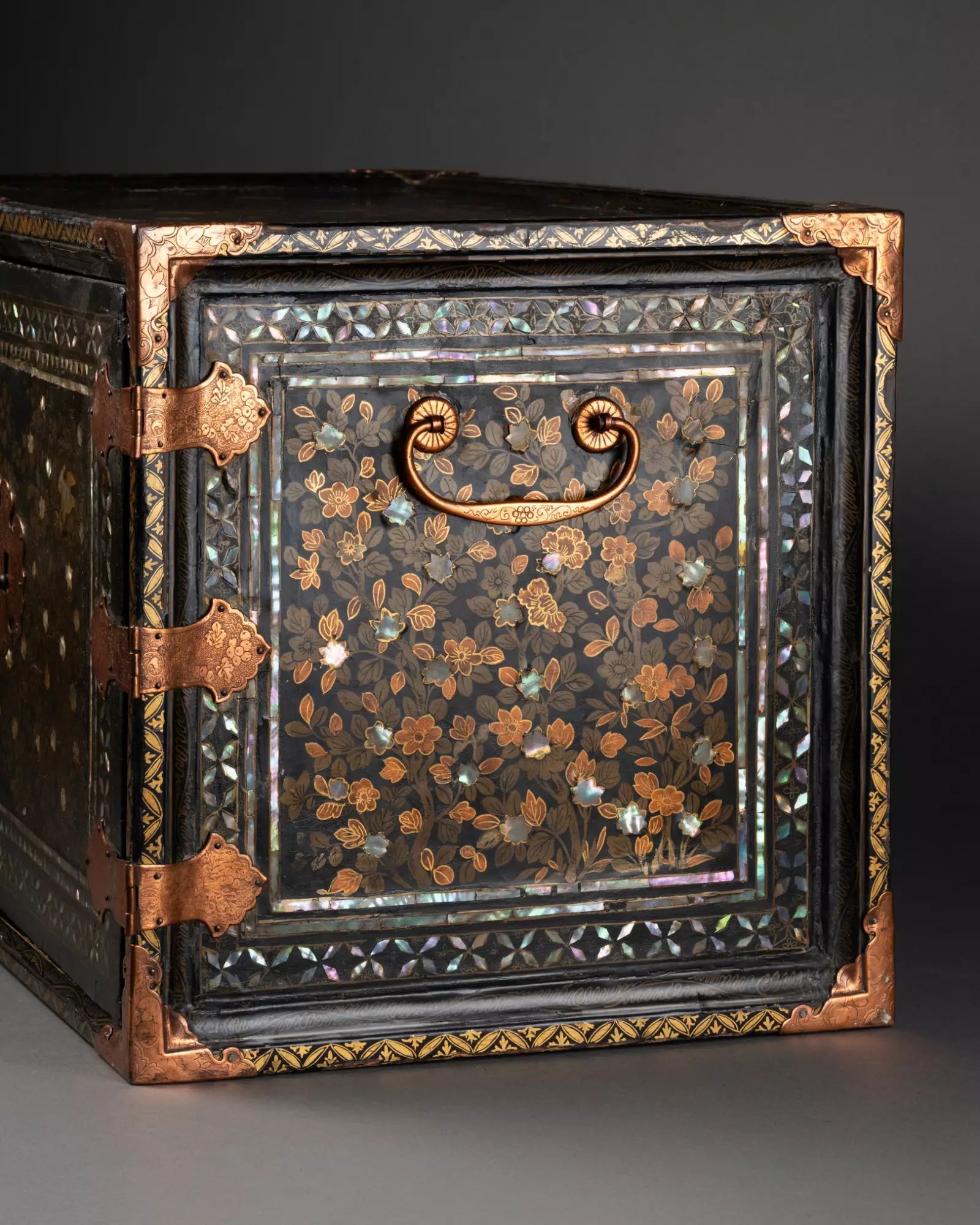
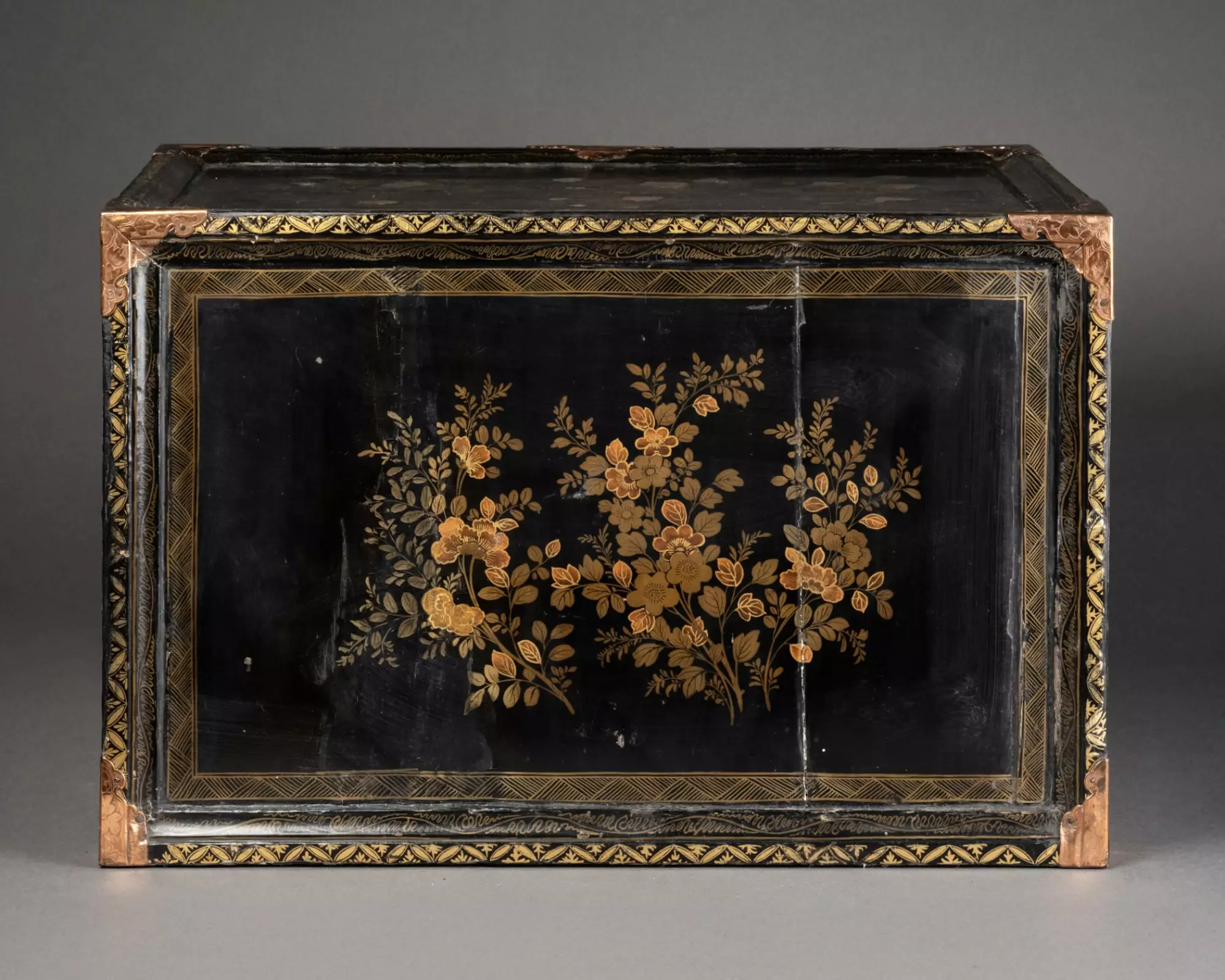
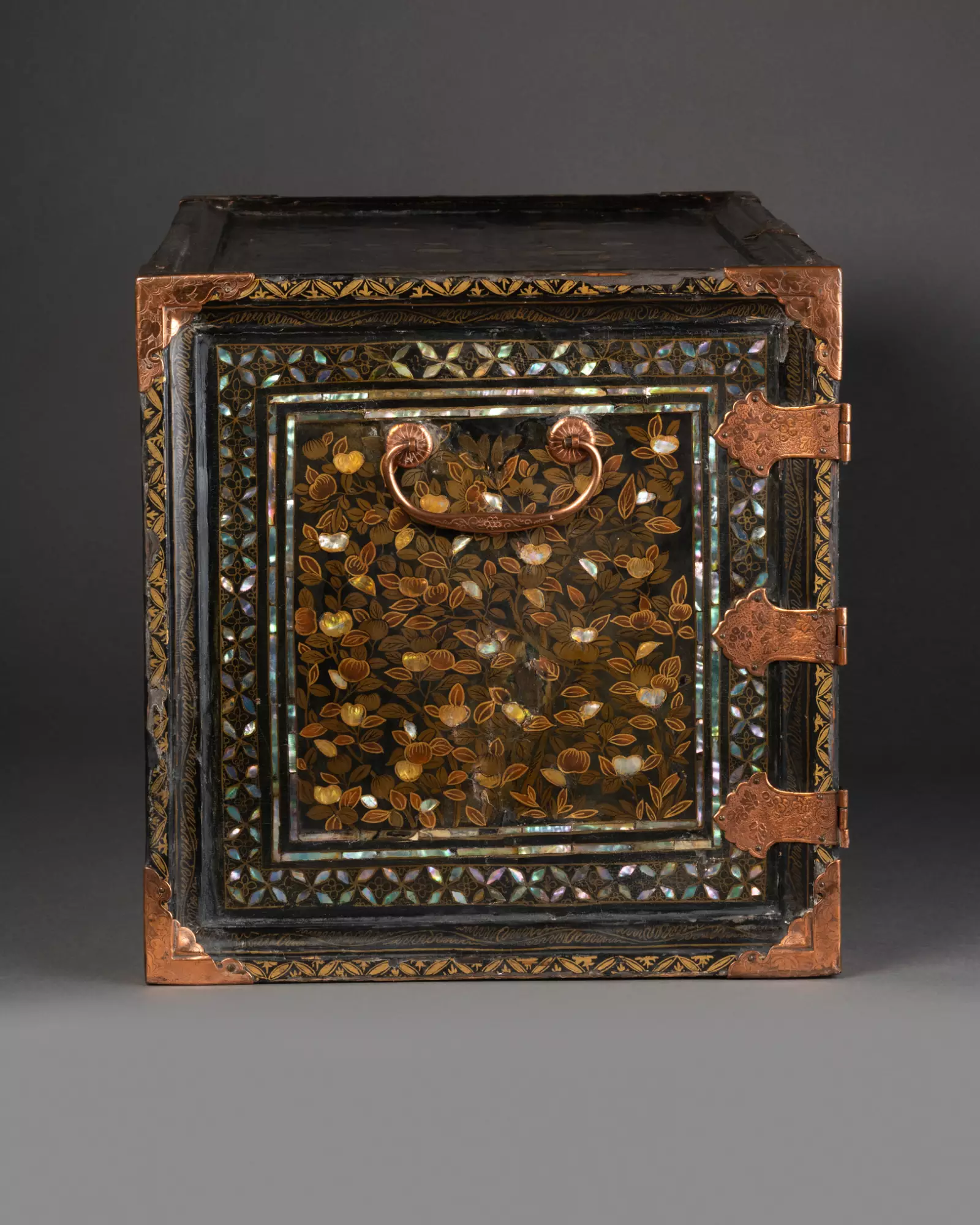
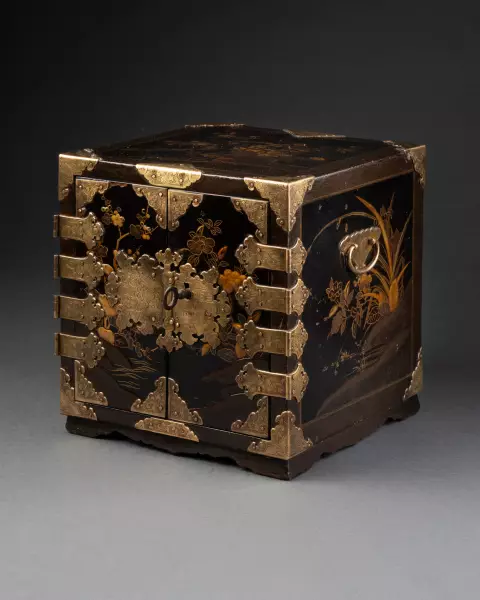
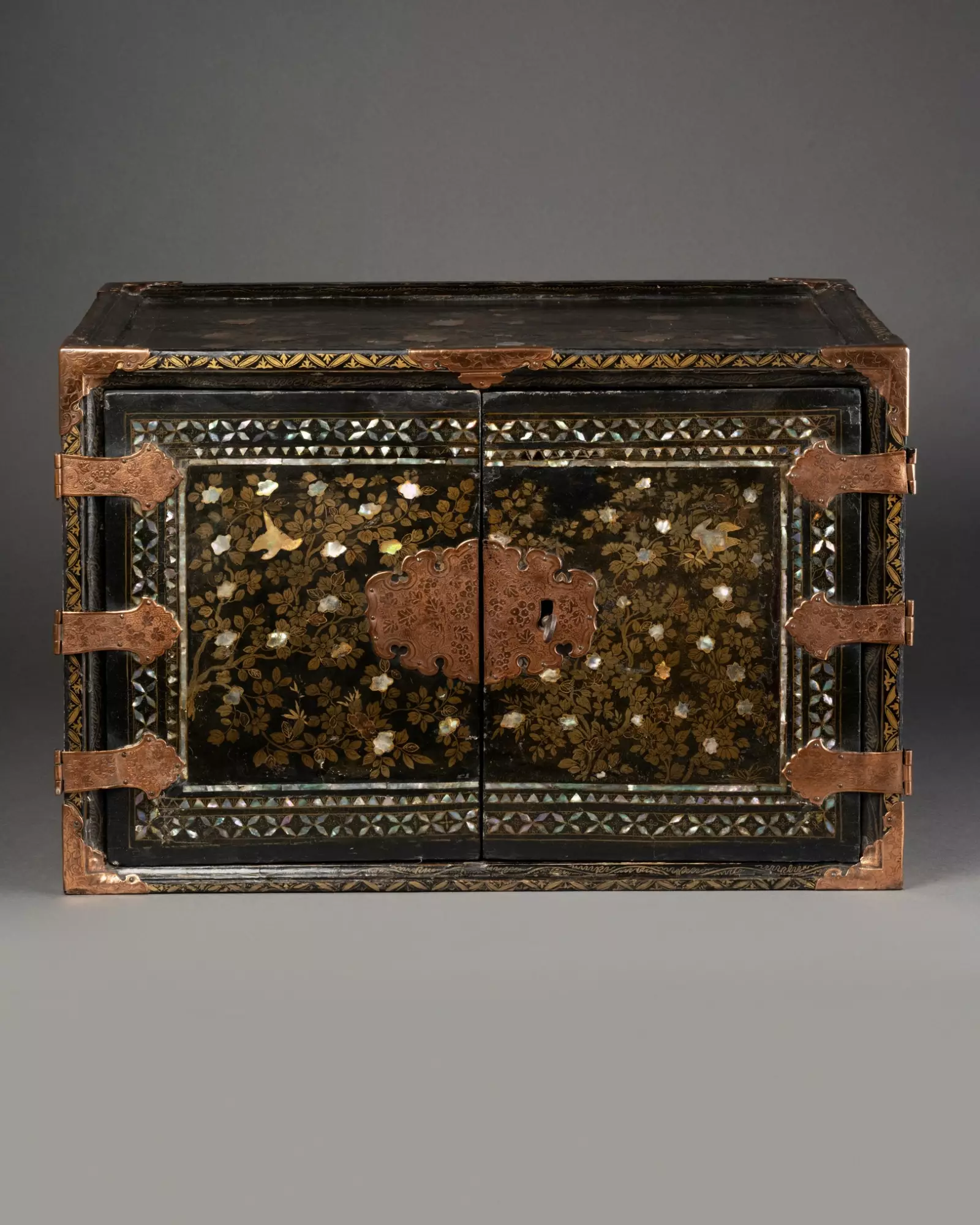
A rare "Nanban" cabinet made of black lacquered wood, decorated with gold powder (*maki-e*) and inlaid with mother-of-pearl (*raden*).
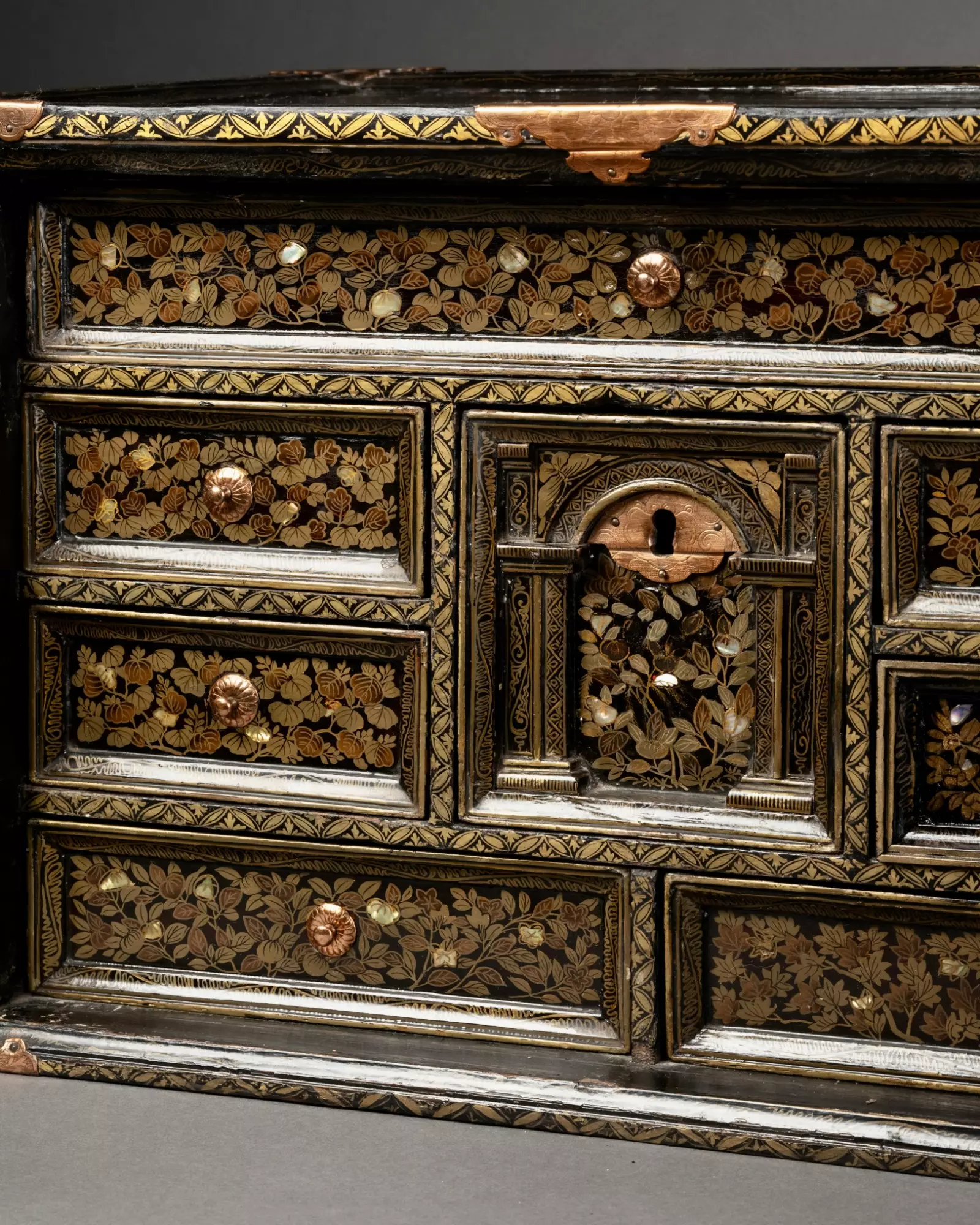
The front, sides, and top feature an elaborate design: geometric mother-of-pearl borders frame clusters of morning glories, maple leaves, and chrysanthemums, accented by scattered petals and swallows rendered in mother-of-pearl.
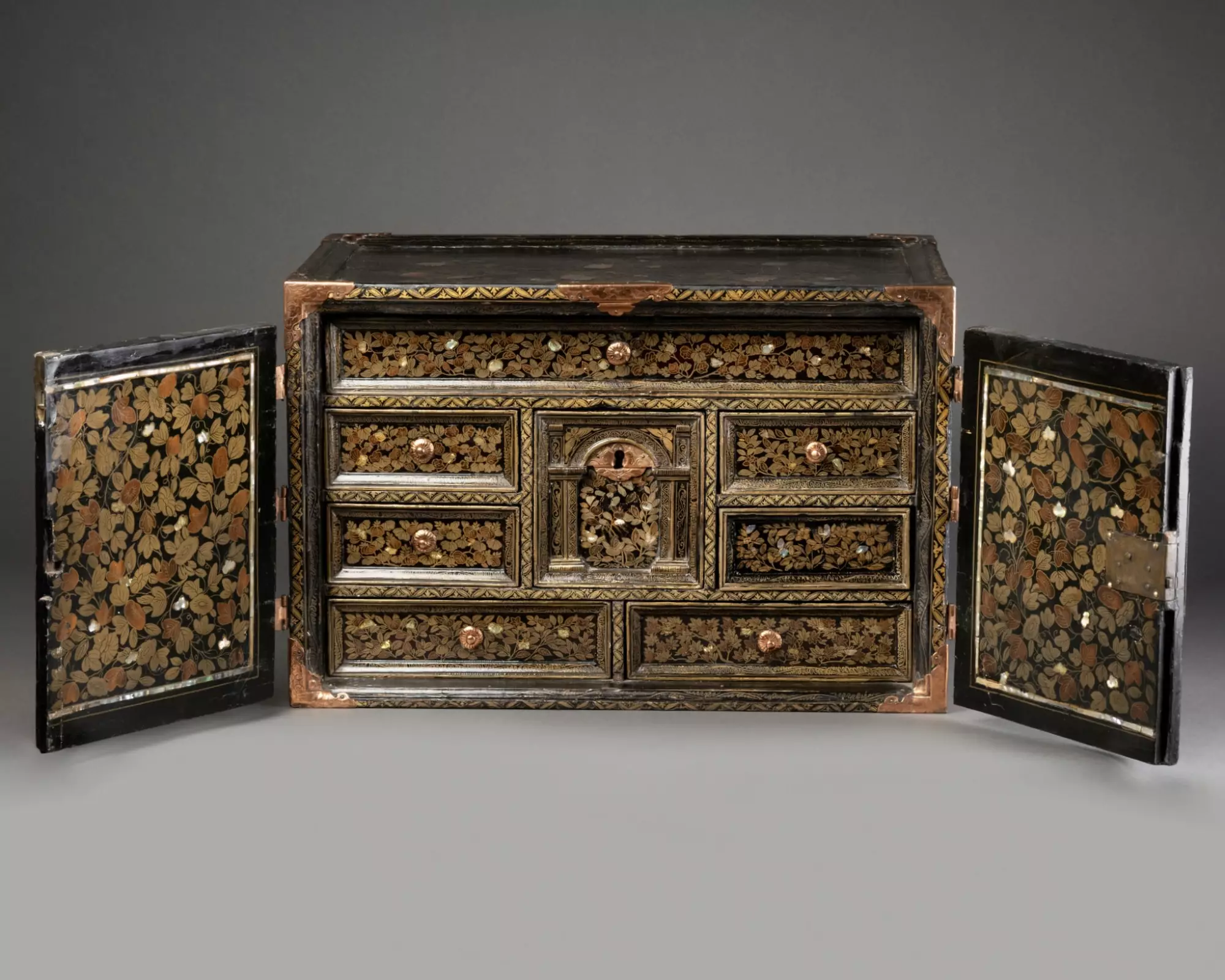
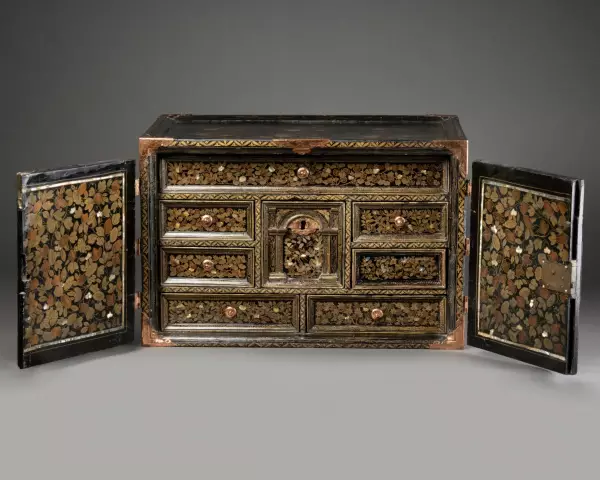
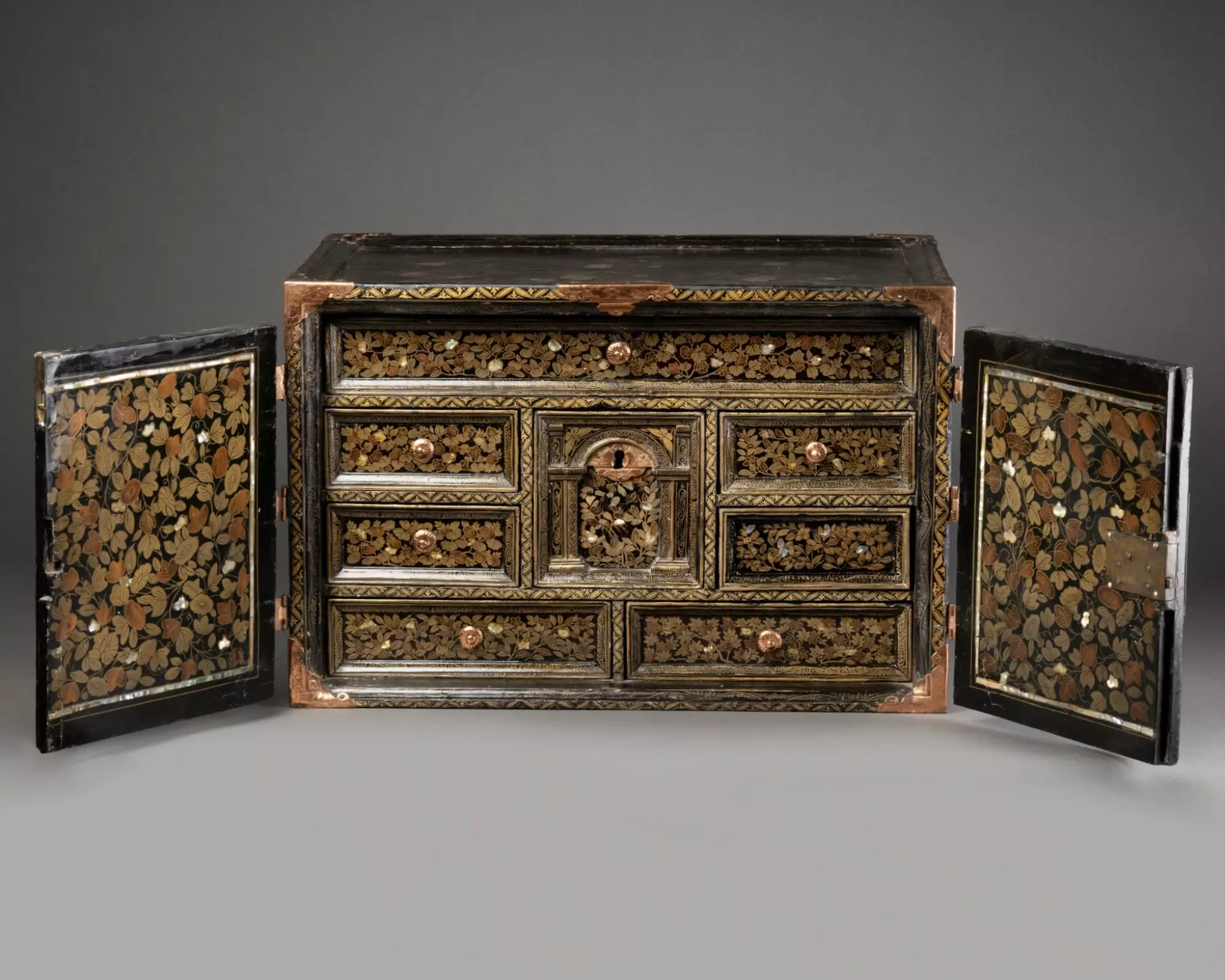
The front opens via two doors to reveal seven drawers and a central niche shaped like a *mihrab*.
The insides of the doors and the drawer fronts display the same dense floral motif, studded with mother-of-pearl petals.

It features exquisite copper fittings—including hinges, corner mounts, and lock plates—delicately chased with floral designs.

Fine condition, with minor restorations consistent with age and use.

Japanese craftsmanship intended for the Portuguese market; late Azuchi-Momoyama period (1573–1603).

Dimensions:
Width: 50 cm; Height: 33 cm; Depth: 32.5 cm.

A very similar model is held by the Museum of Fine Arts in Arras (Inv. No. 2009.0.1).

Our assessment:

The cabinet presented here is a classic example of "Nanban" art.
The term—meaning "Southern Barbarians"—referred to goods produced for Portuguese merchants.
Among these items, cabinets were the most sought-after for export to Europe, where lacquerware was still a novelty and highly prized.
The form of these early cabinets derives from the Iberian *escritorio* (writing cabinet), featuring a central niche reminiscent of the *mihrab* found in mosques—a legacy of the Muslim rule of the Al-Andalus Caliphate. The mother-of-pearl decoration is also inspired by the Muslim craftsmanship of the Mughal Empire—works the Portuguese admired but struggled to acquire.
It is paired with dense floral ornamentation covering the entire surface, following the principle of *horror vacui* (fear of empty space), a key concept in European Renaissance decoration.
Thus, this type of piece—crafted in Japan for the European market—combines a Western form with Asian decoration and a touch of Muslim influence.
Intended for a princely elite, these cabinets are extremely rare today; they were costly to produce and scarce on the market—especially given that the Portuguese were expelled from Japan in 1640, while the Dutch, who were the only ones permitted to trade on the island, held very different tastes.
Japanese Nanban Lacquer Cabinet, circa 1600

Japanese Nanban Lacquer Cabinet, circa 1600

Large pair of gilt-wood torchères, Paris, Louis XVI period

Large pair of gilt-wood torchères, Paris, Louis XVI period

Commode by Pierre Denizot, Paris circa 1770

Commode by Pierre Denizot, Paris circa 1770

Boulle marquetry bookcase, Paris, Louis XIV period

Boulle marquetry bookcase, Paris, Louis XIV period

A Martin varnish table by L. Boudin, Paris, circa 1760

A Martin varnish table by L. Boudin, Paris, circa 1760

Enconchado cabinet in tortoiseshell, mother-of-pearl and bone, Mexico circa 1700

Enconchado cabinet in tortoiseshell, mother-of-pearl and bone, Mexico circa 1700

Commode in rosewood veneer, stamped P. Roussel

Commode in rosewood veneer, stamped P. Roussel

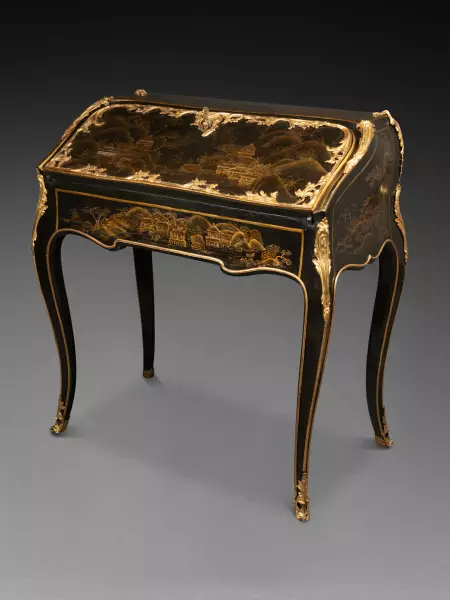
Slant-front desk in Martin varnish by F. Rubestuck, Paris circa 1770

Slant-front desk in Martin varnish by F. Rubestuck, Paris circa 1770

Corner cabinet with Martin varnish decoration, Paris, circa 1750

Corner cabinet with Martin varnish decoration, Paris, circa 1750

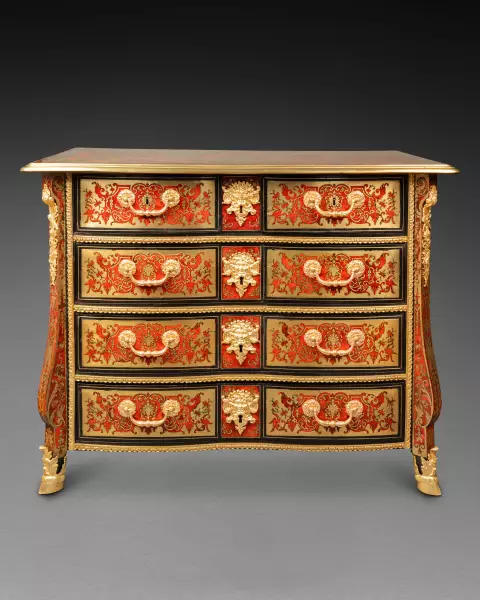
Boulle marquetry commode by N. Sageot, Paris, Louis XIV period

Boulle marquetry commode by N. Sageot, Paris, Louis XIV period

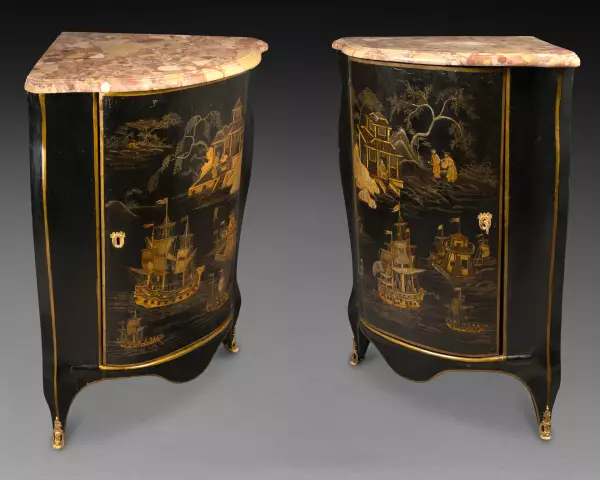
Pair of corner cabinets in Martin varnish by Léonard Boudin circa 1760

Pair of corner cabinets in Martin varnish by Léonard Boudin circa 1760

French fine 18th console

French fine 18th console

Console table from the Château de Chanteloup, Paris, circa 1765

Console table from the Château de Chanteloup, Paris, circa 1765

Convertible chest of drawers, Netherlands circa 1780

Convertible chest of drawers, Netherlands circa 1780

Pair of tea tables, England, early 18th century

Pair of tea tables, England, early 18th century

Red lacquered cabinet, England circa 1700-1720

Red lacquered cabinet, England circa 1700-1720

Pair of Chinese lacquer commodes, England circa 1780

Pair of Chinese lacquer commodes, England circa 1780

Small Japanese lacquer travel cabinet circa 1680 

Small Japanese lacquer travel cabinet circa 1680 

Japanese lacquered travel cabinet, circa 1680

Japanese lacquered travel cabinet, circa 1680

A Chinese lacquer slant-front desk, circa 1760

A Chinese lacquer slant-front desk, circa 1760

Mazarin desk in lacquer imitating Boulle marquetry, Louis XIV period

Mazarin desk in lacquer imitating Boulle marquetry, Louis XIV period

Tea table, China, 18th century, for export to Europe

Tea table, China, 18th century, for export to Europe

18 th Martin varnished office filing cabinet, Paris, Louis XV period

18 th Martin varnished office filing cabinet, Paris, Louis XV period

Lacquered chest of drawers, stamped Pierre Roussel, Paris, circa 1770

Lacquered chest of drawers, stamped Pierre Roussel, Paris, circa 1770

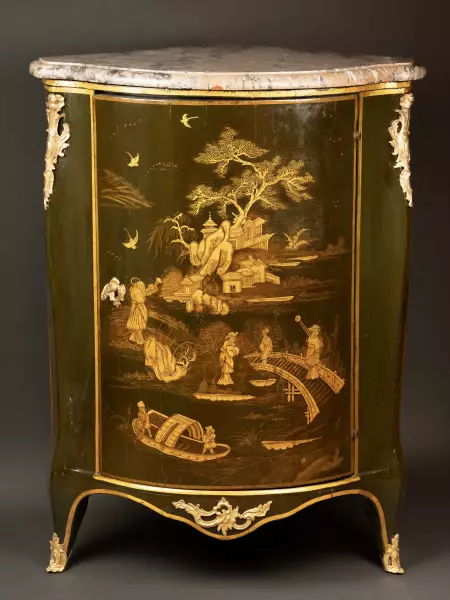
Pair of corner cabinets in green Martin varnish, Paris, Louis XV period

Pair of corner cabinets in green Martin varnish, Paris, Louis XV period

Pair of consoles with putti, Rome circa 1750

Pair of consoles with putti, Rome circa 1750

Travel tric-trac table with P.Denizot system circa 1770

Travel tric-trac table with P.Denizot system circa 1770

Bronze pedestal table attributed to Thomire, Paris circa 1810

Bronze pedestal table attributed to Thomire, Paris circa 1810

Boulle Library with pagoda roof, Paris circa 1700

Boulle Library with pagoda roof, Paris circa 1700

Pair of hanging corners in rosewood, Paris, Louis XV period

Pair of hanging corners in rosewood, Paris, Louis XV period

Flat desk in ebony , François Lieutaud circa 1720

Flat desk in ebony , François Lieutaud circa 1720

Pair of consoles in gilded oak, Paris, Louis XV period

Pair of consoles in gilded oak, Paris, Louis XV period

Tray in pietra dura, Mattia Valenziani, Naples circa 1780-1790

Tray in pietra dura, Mattia Valenziani, Naples circa 1780-1790

Chest of drawers with Martin varnish, Paris Louis XV period

Chest of drawers with Martin varnish, Paris Louis XV period

Console table with « rocaille » decoration, Provence, circa 1730

Console table with « rocaille » decoration, Provence, circa 1730

Pair of Anglo-Chinese style shelves in amaranth, Paris around 1765

Pair of Anglo-Chinese style shelves in amaranth, Paris around 1765

Tripod pedestal table in gilded bronze, Paris circa 1790

Tripod pedestal table in gilded bronze, Paris circa 1790

Living room table attributable to Pierre Gole, Paris Louis XIV period

Living room table attributable to Pierre Gole, Paris Louis XIV period

Two-part marquetry sideboard, attributed to Thomas Hache around 1690

Two-part marquetry sideboard, attributed to Thomas Hache around 1690

Gilded oak console after Lalonde around 1785

Gilded oak console after Lalonde around 1785

Flat desk in amaranth veneer, François Lieutaud circa 1730

Flat desk in amaranth veneer, François Lieutaud circa 1730

Mahogany architect

Mahogany architect's table by P.Pioniez Paris Louis XVI period

Solid mahogany wardrobe by J.H Riesener, Paris circa 1770-1775

Solid mahogany wardrobe by J.H Riesener, Paris circa 1770-1775

Coromandel lacquer cabinet circa 1680-1700

Coromandel lacquer cabinet circa 1680-1700

COLLECTION Furniture